Brazilian Jiu-Jitsu
Brazilian Jiu-Jitsu classes in Catonsville, Maryland, at Baltimore Martial Arts Academy — gi and no-gi, beginners through black belt, for adults and teens. We have taught Brazilian Jiu-Jitsu here since 1995, which makes this one of the oldest BJJ programs in Maryland, and we are the home of GFTeam Maryland. Every new student starts with a free week trial.
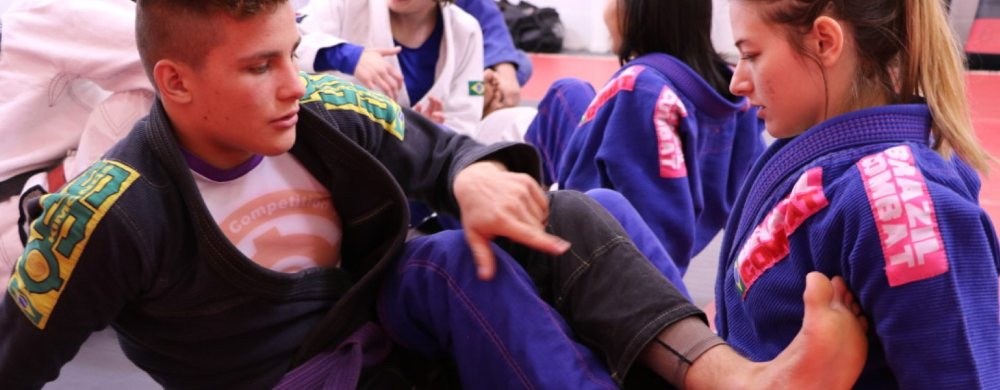
Class details
Who: adults and teens, all levels — including beginner-only classes with no live wrestling
What: gi (uniform) and no-gi classes, sport and self-defence, open mat, private lessons available
When: classes most days — see the class schedule
Where: 6565 Baltimore National Pike, Catonsville, MD 21228 — on Route 40, two miles west of the Beltway, free parking
To start: one week free, up to three classes, no contract, no uniform needed to try
What Brazilian Jiu-Jitsu is
Brazilian Jiu-Jitsu is a grappling art built around takedowns, positional control and submissions — joint locks and chokes. The idea is simple: avoid getting punched or kicked by taking the fight to the ground, where a trained person can control a bigger, stronger, untrained one. It can be trained as a sport, as self-defence, or simply as the best workout you have ever had with a problem to solve attached to it. It has grown faster than any other martial art in the United States for a reason.
Who teaches it

Gary Berger, the owner of the school, is the head instructor of the Brazilian Jiu-Jitsu program. He is a third-degree black belt under Professor Denilson Pimenta, has taught Jiu-Jitsu here since 1995, and has competed successfully for decades — including winning his division and the open division at the IBJJF Miami Open. He also holds a black belt in Kung Fu and a brown belt in Judo, which shows in how takedowns are taught here.

Professor Denilson Pimenta is our professor and the head of GFTeam Maryland — a fifth-degree black belt, a world champion and one of the best-known names in GFTeam. He has taught at the Academy for years and oversees GFTeam Maryland.
Our children’s program is led by Darnel Harrison, a first-degree black belt under Pimenta. See the full instructor list.
GFTeam Maryland
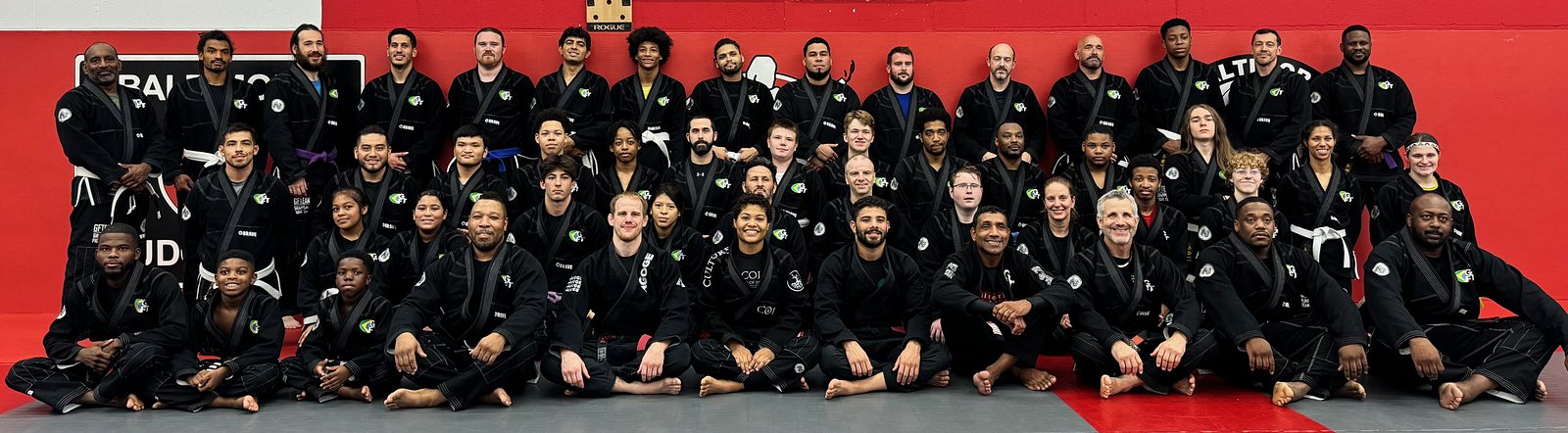
Our Brazilian Jiu-Jitsu program is an affiliate of GFTeam — Grappling Fight Team of Rio de Janeiro — one of the most successful Jiu-Jitsu teams in the world, with world champions including Rodolfo Vieira, Vitor Henrique, Ricardo Evangelista, Igor Silva, Jacob McKenzie and Denilson Pimenta. Baltimore Martial Arts Academy has long been a stop for GFTeam athletes travelling from Brazil to compete in the United States, which means our students regularly get to train with people at the very top of the sport.
Our mission for GFTeam Maryland is to teach authentic Brazilian Jiu-Jitsu, keep the integrity of the complete art, and build life champions as well as athletes. Jiu-Jitsu is a tool for the rest of your life: it builds the confidence, composure and community that make everything else go better — whatever you do for a living.
Gi or no-gi?

We teach both. Gi classes use the traditional uniform, and the grips it allows make for a more technical, methodical game — it is the better place for most people to start. No-gi is faster and closer to what is used in mixed martial arts, and many of our MMA competitors focus on it. Each can be learned without the other, but we recommend beginning in the gi. Most of our students end up doing both.
A short history
Baltimore Martial Arts has taught Brazilian Jiu-Jitsu and Judo since 1995 — about the time “mixed martial arts” became a phrase and the UFC first drew attention to the art. Our earliest students learned a blend of San Shou, Judo and Brazilian Jiu-Jitsu, at a time when only one other school in the Baltimore area was teaching anything like it. Thirty years on, the Academy has grown into one of the region’s established homes for Brazilian Jiu-Jitsu, with a competition team, a GFTeam affiliation and a children’s program of more than 150 students.
What a class looks like
Classes open with a warm-up and movement drills. The instructor then teaches the technique of the day — a position, an escape, a submission or a takedown — and you drill it with a partner, slowly at first and then with resistance. Classes finish with live rounds, called “rolling”: timed, supervised sparring where you try to apply what you have learned. Beginner-only classes skip the live rounds entirely until you are ready; nobody is thrown to the wolves on day one.
Belts and progression
Adults progress from white belt through blue, purple, brown and black, with stripes along the way. Promotions are earned on the mat, not bought. Jiu-Jitsu belts are known for being slow and meaningful: a blue belt here means something, and a black belt typically takes a decade. That is part of the appeal.
Competition — if you want it
Many of our adults and children compete in gi and no-gi tournaments, and our competition team has a long record of individual and team results. Competing is never required. Plenty of our longest-serving students have never entered a tournament and never will.
What to bring to the first class
- A t-shirt or rash guard and shorts or athletic pants without pockets or zips. No uniform is needed to try; if you decide to stay, we will tell you what to buy and where.
- Water. Flip-flops for walking off the mat are a good idea.
- Trimmed nails, no jewellery — for your partner’s sake.
- Arrive ten minutes early so an instructor can meet you first.
Questions new students ask
I have no experience and I am not in shape. Can I start?
Yes. That describes most people on their first day. Beginner-only classes exist for exactly this reason, and the work is scaled to you.
Will I get hurt?
Jiu-Jitsu has no striking, every live round is supervised, and tapping ends anything instantly. Like any contact sport it is not risk-free, but it is one of the safest martial arts to train as an adult, and beginners here do not roll live until they are ready.
How often should I train?
Twice a week is enough to make real progress. Three or more and you will progress quickly. Once a week still works — it just takes longer.
Do I need a gi to start?
No. Try the free week in regular athletic clothes. If you stay, a gi is the first thing to buy for gi classes; for no-gi you need only shorts and a rash guard.
I am over 40. Is this for me?
Yes. Many of our students started in their forties and fifties. The pace of a class is set by the person in front of the instructor, not by the youngest athlete in the room.
Do you offer private lessons?
Yes — call 410-465-7799 to arrange one.
Related programs
Children from age three train in Kids Brazilian Jiu-Jitsu. Students who want striking as well as grappling add Muay Thai, and our MMA program brings the two together. More questions? The FAQ covers most of them, and the class schedule has current times.
From the archive: Fox 45 learns Jiu-Jitsu with us
Patrice Harris of Fox 45 came to Baltimore Martial Arts Academy to try Brazilian Jiu-Jitsu for her “Up to the Challenge” segment. Filmed in December 2008 — and the mats are still the same colour.

Want to study technique between classes? Jitseasy, our free Brazilian Jiu-Jitsu video library, has thousands of instructional videos including exclusive GFTeam content.
Start with a free week
Your first week is free — up to three classes within one week. No contract, no experience and no uniform needed.
Claim Your Free WeekSee Adult Class Times
Prefer to talk first? Call 410-465-7799.
Your first
week is free.
Pick a program and grab a time. We'll take care of the rest.
Book Your Free Week★★★★★ 4.7 on Google · 328 reviews · No experience needed